
Panel Swaps & Service Upgrades — Mill Creek & Snohomish County
A panel or service upgrade replaces your home’s main electrical panel — often the meter base and conductors too — raising capacity from 100 amps to 200 or 400 to carry an EV charger, heat pump, or solar array. Total Wire Electric, a licensed Washington contractor, runs the load calculation, pulls the permit, and coordinates the utility disconnect.
- Since
- 2024
- WA Lic.
- TOTALWE767JH
- Licensed & bonded Washington contractor
- 15 years in the trade
- Residential — Snohomish & north King County
- After-hours emergency calls
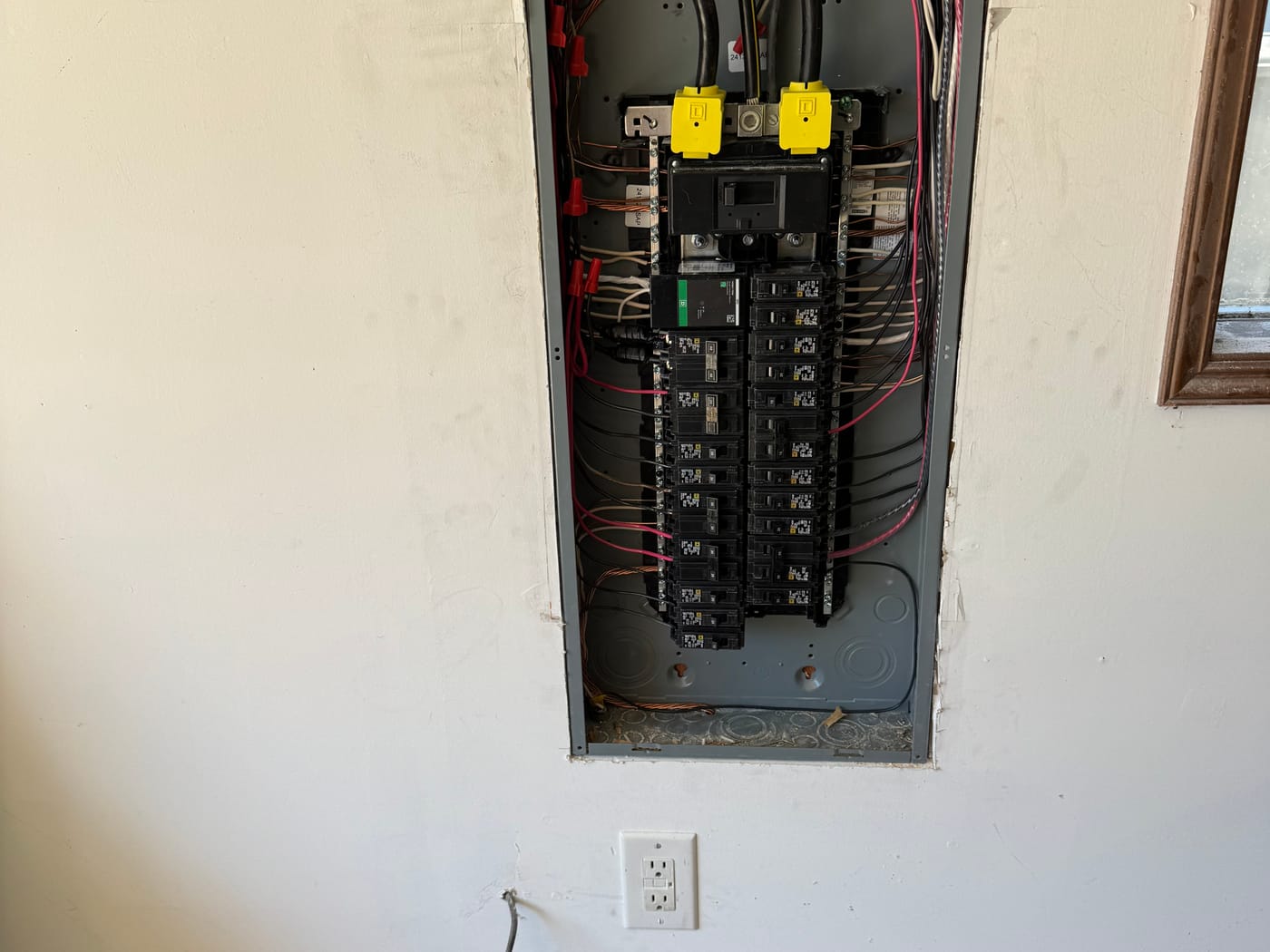
What a panel or service upgrade actually is
A panel upgrade replaces the main service equipment in your home — the breaker panel, and on most upgrades the meter base, the service-entrance conductors, and the grounding electrode system as well. The replacement raises the ampacity of the service so the house can safely carry the loads you plan to add. The most common job across Snohomish County is a 100-amp to 200-amp upgrade on a 1970s or 1980s home whose owner is adding an EV charger and a heat pump in the same project. The second most common is a 200-amp to 400-amp upgrade on a larger home preparing for solar plus battery storage alongside an induction range and two EV chargers. A "panel upgrade" that only swaps the indoor load center is often the wrong scope: if the service from the meter inward is undersized, a new panel is just a fresh label on the same constrained service. The upgrade has to follow the load, which is why the walkthrough starts with a calculation rather than a catalog.
Why homeowners need one
There are four reasons we get called for a panel or service upgrade. The first is added load — an EV charger, a heat pump replacing oil or gas heat, an induction range replacing a gas cooktop, a hot tub, or a solar-plus-battery system pushes the load calculation past what the existing service can carry. The second is age and risk — a Federal Pacific Stab-Lok, Zinsco, or Pushmatic panel has a documented failure-to-trip record and should come out on sight. The third is code compliance triggered by another project — a kitchen remodel, an ADU build, or a permitted addition reveals a panel that no longer meets workspace clearance, lacks AFCI or GFCI protection where it is now required, or fails the new load calculation. The fourth is documentation — a buyer, an insurer, or an inspector flagged the existing service during a transaction and the homeowner needs a permitted, inspected upgrade with a paper trail. All four run through the same scoping process, and all four are residential work, which is the only kind we do.
Service area and permitting across Snohomish County
We pull electrical permits for residential panel and service upgrades across Mill Creek, Lake Stickney, Everett, Edmonds, Bothell, Marysville, Lake Stevens, and Arlington, and south into Seattle, Bellevue, and Newcastle. The permit authority depends on the address: most of unincorporated Snohomish County and many of its cities run electrical permits through Washington Labor & Industries, while some jurisdictions administer their own electrical program — we confirm which applies to your address and pull the correct permit as the licensed contractor of record. The serving utility also varies: Snohomish County PUD covers most of our home territory and coordinates the meter pull and reconnect for panel work, while Seattle City Light and Puget Sound Energy serve the areas to the south. The utility disconnect window is almost always the binding constraint on the calendar, not the inspector, so we book it the day we pull the permit — that date is what sets your install day.
Common scenarios we quote
The 100-amp to 200-amp upgrade on a single-family Snohomish County home with a detached garage and one planned EV charger is the bread-and-butter job. We replace the meter base, the service-entrance conductors, and the panel, and typically add a supplemental ground rod and an intersystem bonding terminal at the meter. The 200-amp to 400-amp upgrade shows up on larger homes preparing for solar plus battery plus two EV chargers; on those we usually set a 200-amp main plus a 200-amp sub-panel rather than a single 400-amp panel, because the dual-200 configuration lines up better with most residential battery inverters. EV-charger prep is a scenario of its own — a hard-wired Level 2 charger can pull up to 60 amps, and a 200-amp service feeding two of them plus a heat pump usually needs a load-sharing setup or a smart panel to manage the peak. Heat-pump prep is the simplest of the four: a single 240-volt double-pole breaker sized to the manufacturer’s minimum-circuit-ampacity rating, provided the service has the headroom the load calc confirms.
The code we follow
Every Total Wire panel and service upgrade is built to the National Electrical Code as adopted by Washington State — the 2023 NEC at the time of this writing — plus the Washington amendments in WAC 296-46B. The work references NEC Article 230 for services, Article 250 for grounding and bonding, Article 408 for panelboards, and Article 220 for load calculations. The single most common reason an upgrade fails a first inspection is a workspace-clearance violation under NEC 110.26 — a panel in a closet with shelving, above a stair landing, or without the required clear space in front of it — so we measure that during the walkthrough and quote relocation when it is not legal. The second most common failure is grounding: a missing supplemental ground rod, an undersized grounding electrode conductor, or a neutral-to-ground bond left in place at a sub-panel. We carry the grounding scope into every quote, and the inspector receives an as-built panel directory at the final visit so the labels match what is actually in the panel.
What we will not do
We will not pull a permit for an upgrade we did not scope ourselves, and we will not work behind a permit another contractor pulled. We will not upsize a panel while leaving undersized service-entrance conductors or grounding in place when the load calculation says they have to grow — a 200-amp panel landed on 100-amp wire is a violation and a fire risk a future inspector or buyer will rightly flag. We will not install a panel with a known field-failure record or re-use old breakers in a new panel, because most listed panels are tested only with the breaker line the manufacturer ships. And if a project pushes past residential work we can do well — three-phase service, large commercial, or a grid-tied solar interconnection beyond residential scope — we say so up front and point you to someone we trust rather than learn on your home.
How a Total Wire panel or service upgrade runs
Every upgrade follows the same path from walkthrough to inspection sign-off. The utility disconnect drives the calendar; the install itself is usually a single window.
1. On-site walkthrough and load calculation
A licensed electrician walks the existing service — the meter base, the grounding electrode system, the main bonding, and the panel itself — and runs a NEC Article 220 load calculation against your real usage plus anything you plan to add: an EV charger, a heat pump, an induction range, a hot tub, or a shop. The calculation, not a guess, decides whether a panel swap is enough or the whole service has to grow.
2. Written quote with the permit and utility work included
You receive a single written scope that covers the panel and breakers, the service-entrance conductors and any mast or riser the change triggers, grounding upgrades, the electrical permit, and the utility disconnect coordination. If we open the work and find a hidden condition — a corroded service neutral, undersized conductors, or knob-and-tube behind the drywall — we stop and re-quote before continuing rather than surprise you at the end.
3. Permit pull and utility scheduling
We pull the electrical permit through Washington Labor & Industries or the local jurisdiction with authority over your address, and we coordinate the temporary disconnect with the serving utility — Snohomish County PUD across most of our home territory, Seattle City Light or Puget Sound Energy to the south. The utility disconnect window is usually the constraint that sets your install date, so we book it as soon as the permit is in.
4. Install day
The utility pulls the meter, and we cut over the service-entrance conductors, set the new panel, land every branch circuit with a labeled directory, drive supplemental ground rods where required, and bond the neutral correctly at the service disconnect. Most 200-amp residential upgrades are a single-day install with a several-hour power-out window arranged with you in advance.
5. Inspection and sign-off
The inspector verifies the workmanship against the current NEC and the Washington amendments, signs the inspection record, and the utility re-energizes the service. We carry the job through that sign-off and keep a copy of the permit and the as-built panel directory on file — the documentation an appraiser, insurer, or future buyer will eventually ask for.
Frequently asked questions
- How much does a panel or service upgrade cost?
- It depends on the scope, so we quote a fixed written number after the walkthrough rather than guess over the phone. A straightforward panel swap costs less than a full service upgrade that also replaces the meter base, mast, and service-entrance conductors; jobs that add a sub-panel, relocate the panel, or tie into solar and battery cost more. You get the whole number in writing — panel, permit, utility coordination, and any code items the work triggers — before anything starts.
- What is the difference between a panel upgrade and a service upgrade?
- A panel upgrade replaces the indoor load center and the breakers. A service upgrade replaces everything from the utility connection inward — the meter base, the service-entrance conductors, the mast and riser, and the panel. Many Snohomish County homes built before the mid-1980s with a 100-amp service need the full service upgrade, not just a panel swap. We tell you during the walkthrough which one your home actually needs and quote accordingly.
- Do I need a permit, or can you just swap the panel?
- A panel or service upgrade always requires an electrical permit in Washington — through Labor & Industries or the local jurisdiction with authority over your address. Any electrician offering to swap a panel without a permit is exposing you to a failed home sale later, an insurance denial after a fault, and enforcement against the contractor. We pull every permit in-house and carry the work through inspection sign-off; that is non-negotiable.
- Will a panel upgrade let me add an EV charger and a heat pump?
- Often yes, but a NEC Article 220 load calculation has to confirm it for your specific home. A 200-amp service supports most Snohomish County homes that want one Level 2 EV charger and a heat pump alongside existing loads. A home already running electric heat, an induction range, and a hot tub may need a 400-amp service or a load-management device instead. We run the calculation during the walkthrough so you know before you spend.
- How long is the power out during the install?
- Plan on a several-hour power-out window for a typical 200-amp upgrade. The work starts when the utility pulls the meter and ends when the inspector signs off and the utility re-energizes the service. If the panel sits in a tight or unusual location, or the service mast also needs replacing, we tell you ahead of time that the window may stretch toward a full day. We do not open a service we are not confident we can close the same day.
- My panel is a Federal Pacific or Zinsco — should it be replaced?
- Yes. We replace Federal Pacific Stab-Lok, Zinsco, and Pushmatic panels on sight because of their documented failure-to-trip record — the breaker can fail to open on a fault, which is a fire risk the insurance industry already recognizes. We will not refuse to work in a home that has one, but we will tell you plainly what it is and why it should come out.
- Does the upgrade have to meet workspace-clearance rules?
- It does, and that often decides where the new panel can go. NEC 110.26 requires clear working space in front of the panel — roughly 30 inches of width, 36 inches of depth, and full headroom — kept free of storage. If the existing panel is buried in a finished closet, behind cabinetry, or above a stair landing, we flag it during the walkthrough and quote relocation as part of the scope rather than re-energize a non-compliant install.
- Can you handle a sub-panel or a generator interlock at the same time?
- Yes. If the project includes a detached-garage sub-panel, a shop circuit, or an interlocked portable-generator inlet, we scope it into the same permit and the same install window. Bundling avoids a second permit trip, a second inspection, and a second power-out day. A common pairing on Snohomish County homes is a 200-amp main panel upgrade plus a sub-panel to a detached garage, shop, or ADU.
Book a panel-upgrade walkthrough
Tell us about your panel and the loads you plan to add, and we will follow up to scope the upgrade and schedule a walkthrough.